

Bringing a better nbn broadband experience to the ACT
Last updated: 23 September 2026
7-minute read
Get ready for faster nbn speeds and reliable broadband as we bring more fibre to the nation’s capital.
In this story:
Faster nbn broadband to power more
ACT suburbs being upgraded
Who are our Delivery Partners?
What’s involved in upgrading our network
Why the ACT nbn network upgrade is different
The rollout is underway
What to expect during the survey phase
What to expect during the construction phase
Remediation and repair during nbn works in the ACT
Get more information
Staying safe from scams
If you live or work in the Australian Capital Territory (ACT), you may see some exciting changes to your internet over the next few years.
We’ve started to upgrade around an additional 97,000 homes and businesses that are on the nbn® network in the ACT from their current nbn® Fibre to the Node (FTTN) connections. We expect that more than 95 per cent* of those FTTN premises will have the option to upgrade to nbn full fibre via Fibre to the Premises (FTTP).^
These premises join the more than 38,000 homes and businesses connected to the nbn network that can already order an upgrade, thanks to nbn’s existing upgrade programs, and the 40,000 premises that were served by nbn FTTP in the initial nbn network rollout.
Faster nbn broadband to power more
With the growing number of connected devices and ever-increasing data usage in Australian homes and businesses, having access to fast broadband is crucial – now and for the future.
That’s why we’re upgrading parts of the nbn network in the ACT with more than 95 per cent of premises being upgraded having the option to upgrade to nbn full fibre.
nbn full fibre is more reliable than nbn FTTN and enables access to nbn’s fastest residential upload and download speeds.#
Work on the upgrades has begun – with help from nbn’s Delivery Partners, Ventia and Service Stream – and will be completed progressively, with all upgrades expected to be finished by the end of 2030.
ACT suburbs being upgraded
Some premises in the following ACT suburbs will be progressively upgraded from nbn FTTN by 2030^:
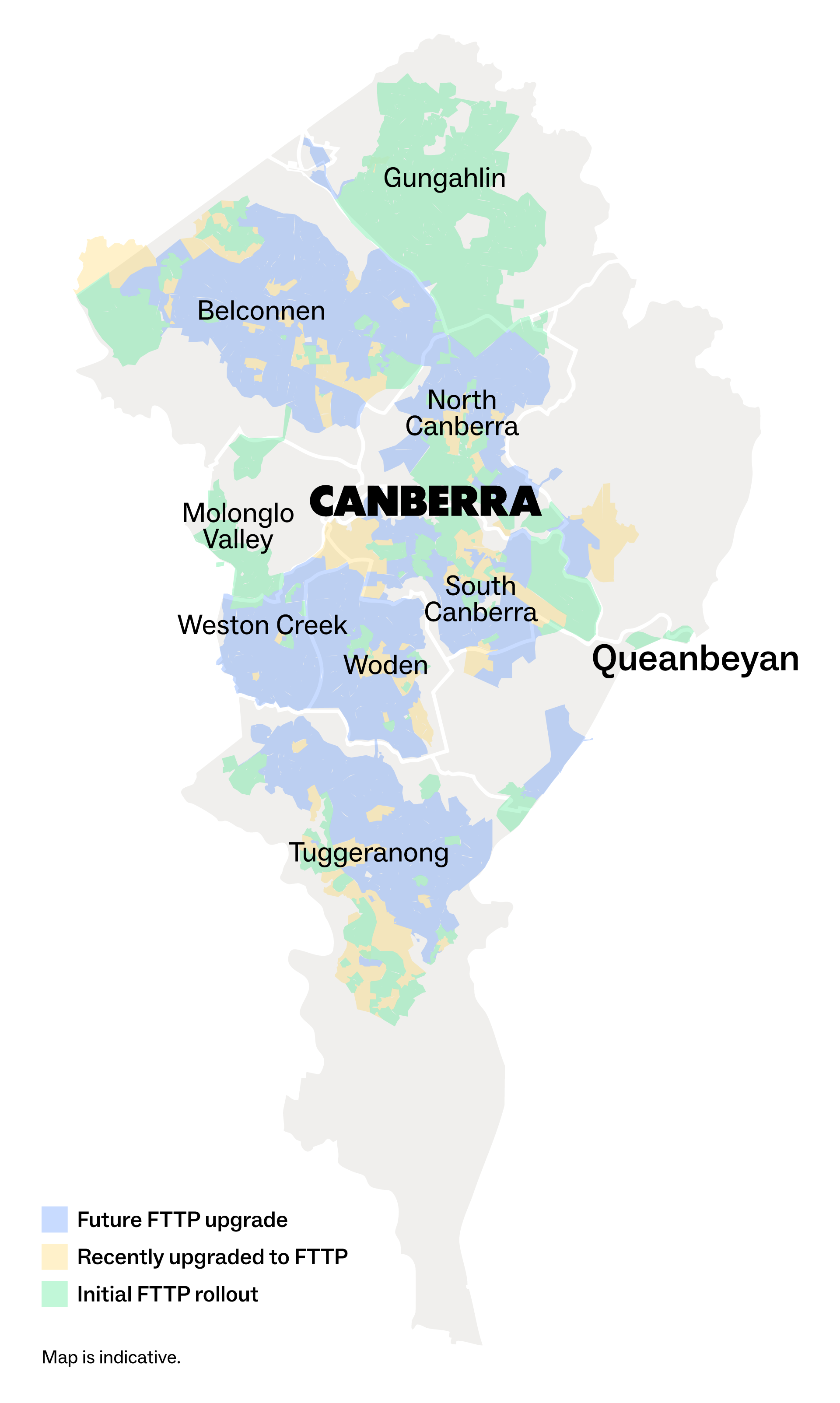
- Acton
- Ainslie
- Aranda
- Barton
- Belconnen
- Braddon
- Bruce
- Calwell
- Campbell
- Canberra Central
- Chapman
- Charnwood
- Chifley
- Chisholm
- Conder
- Cook
- Curtin
- Deakin
- Dickson
- Downer
- Duffy
- Evatt
- Fadden
- Farrer
- Fisher
- Florey
- Flynn
- Forrest
- Fraser
- Fyshwick
- Garran
- Gilmore
- Giralang
- Gordon
- Gowrie
- Greenway
- Griffith
- Hackett
- Hall
- Hawker
- Higgins
- Holder
- Holt
- Hughes
- Hume
- Isaacs
- Isabella Plains
- Kaleen
- Kambah
- Kingston
- Latham
- Lawson
- Lyneham
- Lyons
- Macarthur
- Macgregor
- Macquarie
- Mawson
- McKellar
- Melba
- Monash
- Narrabundah
- O'Connor
- O'Malley
- Oxley
- Page
- Parkes
- Pearce
- Phillip
- Pialligo
- Red Hill
- Reid
- Richardson
- Rivett
- Scullin
- Spence
- Stirling
- Symonston
- Theodore
- Torrens
- Tuggeranong
- Turner
- Wanniassa
- Waramanga
- Watson
- Weetangera
- Weston
- Weston Creek
- Yarralumla
Check your address
Who are our Delivery Partners?
Ventia and Service Stream will undertake the design and construction work on behalf of nbn. During the survey and construction phases, they will be responsible for all interactions and communications with affected premises owners.
If you have any concerns or questions about the works being carried out in your area, please contact the Delivery Partner for your region. It’s also important that the Delivery Partners have your correct contact details to keep you up to date and notify you of works.

North Canberra
If you live in suburbs in the north of Canberra, your nbn Delivery Partner is Ventia.
Website: Ventia
Phone: 1300 275 799
Email: stakeholder.telco@ventia.com
Register your contact details with Ventia.

South Canberra
If you live in suburbs in the south of Canberra, your nbn Delivery Partner is Service Stream.
Website: ServiceStream
Phone: 1800 716 226
Email: enquiries.telco@servicestream.com.au
What’s involved in upgrading our network
There are three phases of work to upgrade eligible premises in the ACT. Eligible premises will receive communications in the mail from nbn’s Delivery Partners before each phase starts, so keep an eye out for these notifications.
The three phases are:
1. Survey (network design)
During this phase, nbn Delivery Partners Ventia and Service Stream will assess existing underground and aerial infrastructure and design the network. This phase generally takes anywhere from four to around eight months.
2. Construction
This is the physical construction of the network. It means a fibre optic cable will be connected from the street to your premises via the existing nbn (or newly-built) telecommunications pathway in areas where nbn is the statutory infrastructure provider (SIP).+
It’ll then be connected to a small nbn utility box installed on an outside wall of your building – this is a ‘premises connection device’ (PCD). This stage can generally take up to approximately 14 months.
3. After construction
Your premises will be declared ‘Ready for Order’ approximately two months after the construction phase finishes.
If you’re an eligible customer, you’ll be notified that you can order an nbn full fibre service. From there, simply place an order with your preferred phone and internet provider that provides services over the nbn network.
Why the ACT nbn upgrade is different
Upgrading the nbn network in the ACT is one of the most unique and complex builds in our history. It’s a big job – and it comes with some specific local challenges.
A smart mix of underground and aerial
Getting the ACT connected to nbn full fibre will involve a hybrid approach: building underground, and upgrading existing aerial infrastructure.
This will help us deliver fast speeds and future-ready broadband, while also being mindful of residents and the streetscape.
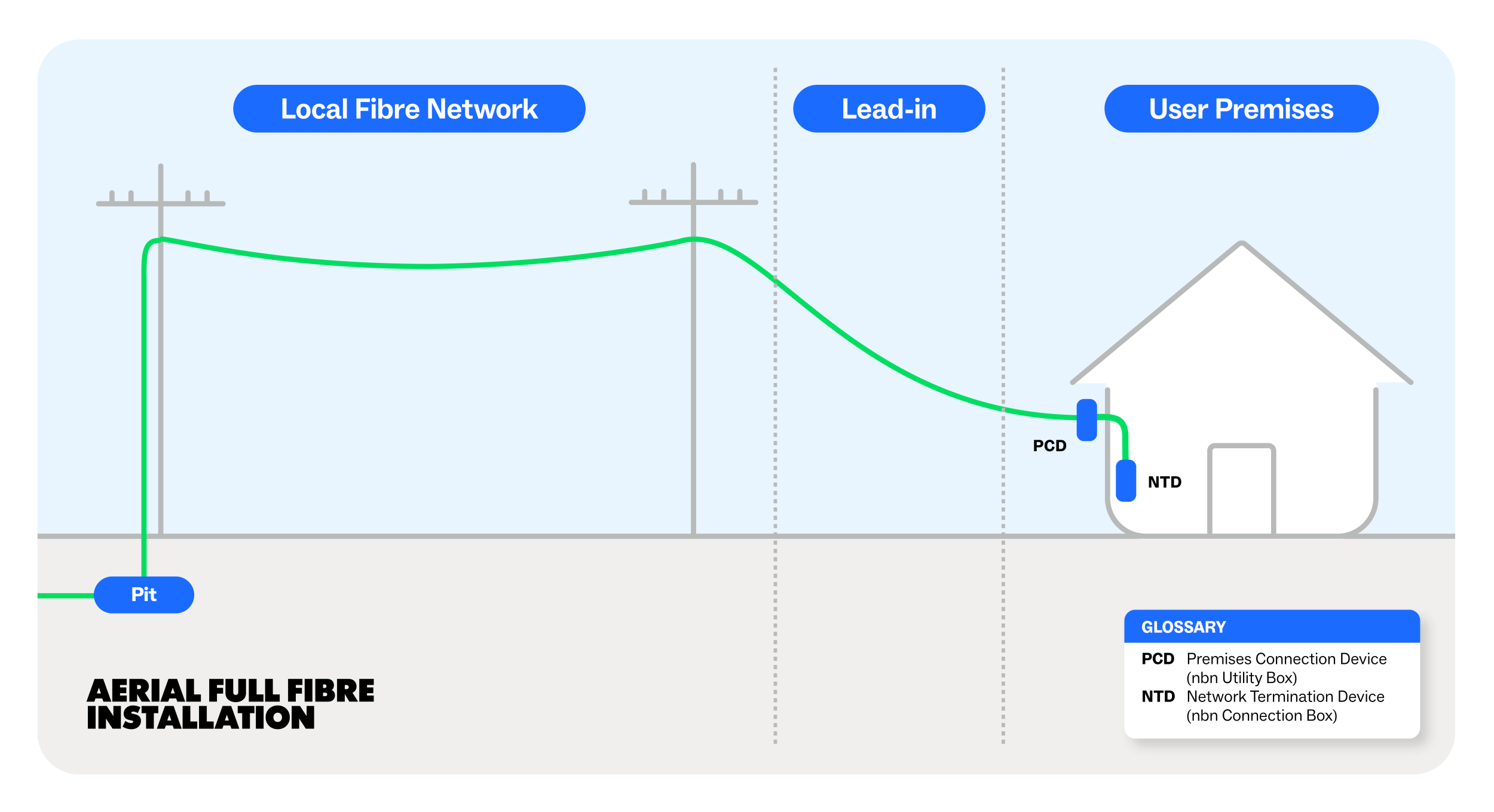

Most of the upgrade will go underground
Around 90 per cent of the FTTN to FTTP nbn network upgrade is expected to involve a new underground build. This means we’ll be carrying out a significant amount of civil works in road reserves, public spaces and front yards.
Why underground? We conducted feasibility trials in Canberra that revealed underground builds are more efficient and less disruptive to residents. Plus, it means we can minimise accessing private properties.
A complex rollout
Unlike many other parts of Australia, around 98 per cent of nbn FTTN premises in the ACT use backyard power poles owned by Evoenergy.
Due to power poles being in the backyard rather than the front, this makes aerial upgrades here more complex than usual. It also means the ACT rollout will be one of the most challenging we’ve done so far.
Aerial upgrades, only where necessary
Under our hybrid upgrade approach, a small number of premises will stay connected via existing backyard aerial pathways.
We’ll only use aerial upgrades where building underground isn’t practical or would cause too much disruption.
These upgrades will be carried out in collaboration with Evoenergy, which owns the aerial network. In some cases, they may involve multiple backyard visits, temporary power interruptions and, in rare cases, removal of vegetation or structures.
We understand this can be inconvenient, so we’ll work closely with Evoenergy and affected residents to keep disruptions to a minimum, and keep you informed.
Private land access and installation
As part of the rollout, we’ll be installing nbn utility boxes (known as a ‘Premises Connection Device’ or ‘PCD’) on the outside of properties. This will involve accessing private land so our Delivery Partners will work closely with affected residents before commencing work, and care will be taken to minimise disruption.
Minimising impact, protecting vegetation
We know how important the ACT’s trees and streetscapes are. That’s why we’re working closely with the ACT Government to help protect vegetation on private property and within the road reserve.
What to expect and your options
If your home or business is eligible, you’ll receive advance notice (like the one pictured) about surveys or construction work that may be needed.
You can choose to opt out but, please keep in mind, if you do:
- your premises will not be upgraded from nbn FTTN to a full fibre nbn connection during this network rollout
- your decision may impact the ability of your neighbours to upgrade

Example of notice.
The rollout is underway
The survey phase is well underway and construction work has started. We expect to complete the upgrade program by the end of 2030.
This means, depending on where your suburb sits in the timeline, if your premises is eligible, you may be able to order an nbn full fibre service from as early as 2026.
Works are being undertaken progressively across Canberra, with construction completed either across whole suburbs, or in stages. As a result differing parts of some suburbs may be completed at different times.
For those living and working in any of the following suburbs, you may have already noticed activity happening in the area. If not, stay tuned.
Suburbs where the survey phase is underway include:
| Suburb | Delivery Partner |
|---|---|
| Barton | Service Stream |
| Calwell | Service Stream |
| Chisholm | Service Stream |
| Cook | Ventia |
| Garran | Service Stream |
| Hughes | Service Stream |
| Isabella Plains | Service Stream |
| Kambah | Service Stream |
| Macquarie | Ventia |
| Oxley | Service Stream |
| Phillip | Service Stream |
| Richardson | Service Stream |
| Theodore | Service Stream |
| Wanniassa | Service Stream |
| Weetangera | Ventia |
Suburbs where survey phase will commence next and indicative timeframes:
| Suburb | Delivery Partner | Indicative start date |
|---|---|---|
| Chapman | Service Stream | Planned to commence October - December 2026 |
| Coombs | ||
| Curtin | ||
| Deakin (Stage two) | ||
| Duffy | ||
| Farrer | ||
| Holder | ||
| Mawson | ||
| Pearce | ||
| Rivett | ||
| Stirling | ||
| Torrens | ||
| Weston | ||
| Downer | Ventia | |
| Hackett | ||
| Lyneham | ||
| O'Connor | ||
| Watson |
What to expect during the survey phase
Authorised nbn Delivery Partners in your area
Our Delivery Partners will be walking the streets, taking photos and measurements, surveying areas, assessing the existing telecommunications network in your street, speaking with landowners, and organising meetings with the wider community.
Minimal disruption
Rest assured, most of the work will involve hand digging and there may be the occasional use of vacuum trucks.
Access to private property
Our Delivery Partners will need to inspect the planned pathway for installing a lead-in cable at your premises, and the planned installation location for the nbn utility box (PCD).
Notification from us
Part of the planned nbn upgrade? You’ll receive notification from our Delivery Partners outlining their proposed activities. This may include needing to access your front yard to assess your current nbn connection.
If you have any questions or concerns about the proposed activities, you can contact the nbn Delivery Partner for your area (details follow).
What to expect during the construction phase
Suburbs where construction is underway:
| Suburb | Delivery Partner |
|---|---|
| Calwell (Stage one) | Service Stream |
| Deakin (Stage one) | |
| Fadden | |
| Forrest | |
| Gowrie | |
| Griffith (Stage one and two) | |
| Isabella Plains (Stage one) | |
| Macarthur | |
| Monash | |
| Narrabundan (Stage one) | |
| Red Hill (Stage one) | |
| Evatt | Ventia |
| Florey | |
| Giralang | |
| Hall | |
| Higgins | |
| Holt (Stage one and two) | |
| Latham (Stage one and two) | |
| McKellar | |
| Melba |
Suburbs where construction will commence next:
| Suburb | Delivery Partner | Indicative construction commencement date |
|---|---|---|
| Chisholm | Service Stream | Planned to commence October - December 2026 |
| Fisher | ||
| Gilmore | ||
| Hume | ||
| Isabella Plains | ||
| Jerrabomberra | ||
| Monash | ||
| Richardson | ||
| Waramanga | ||
| Weston | ||
| Macgregor | Ventia |
The construction phase on public land is a critical part of our FTTP upgrade. It involves building the underground fibre network in road reserves, on verges and other public spaces in front of premises.
Civil works in road reserves and on verges
Fibre will be laid in trenches or conduits within the road reserve or public verge – the strip of land between the road and private property boundaries.
This work may involve:
- Trenching – digging narrow trenches to install new conduits or fibre cables.
- Underboring – used to avoid disturbing hard surfaces like driveways or footpaths.
- Pit and duct upgrades – existing pits may be repaired or replaced, and new ones installed where needed.
Expect to see heavy equipment and machinery in the street during construction works.
Construction is typically conducted in stages and may involve several visits for:
- Initial trenching and conduit installation
- Fibre hauling and splicing
- Testing and quality assurance
Traffic and pedestrian management
Construction may require temporary road closures – where necessary for safety, detours or traffic control measures will be in place.
Vegetation and environmental considerations
We may trim or remove vegetation if it obstructs access to pits or trenching paths.
To help protect Canberra’s trees, we follow tree management standards agreed with the ACT Government.
If you know of any trees on your property that are protected or were planted under a Canopy Contribution Agreement, please proactively reach out and let us know via your Delivery Partner (details follow). If you’re unsure, and our works are proposed near trees on your property, your Delivery Partner will make contact with you prior to works commencing.
Underground fibre deployment
For most eligible ACT residents, during construction, fibre optic cables will be installed underground from the street to your home, and a Premises Connection Device (PCD) will be installed on an exterior wall of the home.
Drilling, boring and trenching will be required as part of the cable installation process. This will involve excavation in front yards, gardens and driveways to allow for proper cable laying.
In most cases, the fibre cables will need to be trenched in from the street. This is the first and cheapest option. The trenches are 150mm deep and will often be dug in by hand. We’ll aim to minimise disruption, but some surface removal and restoration is likely to be necessary including:
- Temporary removal of pavers or concrete sections
- Disturbance to garden beds or lawns
- Potential removal of vegetation or small structures in rare cases.
Underboring will be used in cases where hard surfaces or tree roots make it not feasible to trench. This is a method used to install cables or pipes beneath the ground without digging a trench across the surface.
While this method helps to reduce surface disruption, entry and exit points still need to be dug, so even if this method is used some digging may be required in front yards or garden areas to connect the cable properly.
If you have specific concerns or preferences about the path the fibre will take through your front yard or where the external connection box (PCD) will be installed, we strongly encourage you to contact your Delivery Partner by phone or email (details follow) during the survey and/or construction phase.
While every effort will be made to accommodate your preferences, there may be limitations due to technical, safety or regulatory constraints. Engaging early allows you to understand what’s possible and gives you the best chance of achieving a solution that works for your property.
In some cases, residents who want a particular outcome (such as a specific fibre route) may choose to do preparatory work themselves, like digging a trench, to help ensure the fibre follows their preferred path. The following information can help with this: FTTP Cable Pathways Fact Sheet.
Before doing any preparatory work yourself, we encourage you to speak with your Delivery Partner to discuss your specific circumstances. The Delivery Partners have an end-to-end view of the network design and can provide tailored advice for your property.
Aerial fibre deployment
For backyard aerial deployments, which will apply to a small number of premises, fibre will be strung from the street or distribution point to the backyard pole. The cable is then extended to the premises, terminating at a PCD mounted on the outside of the home.
This process may require:
- Multiple backyard visits – technicians will need to enter backyards and coordinate with residents to assess aerial poles; remediate, repair or replace poles; and install nbn infrastructure. Technicians need safe and clear access to backyards. If gates are locked or pets are present, someone must be home to allow entry.
- Pole remediation/repair or replacement by Evoenergy.
- Temporary power interruptions – particularly if poles need to be repaired, remediated or replaced.
- Vegetation trimming or temporary removal of obstructions – like sheds or fences.
Remediation and repair during nbn works in the ACT
nbn and our delivery partners take care to plan and deliver construction works in a way that minimises disruption to residents and the local community. However, construction works will involve some impacts to private property, such as driveways, gardens and lawns, as well as public land, including nature strips, verges, footpaths and other shared areas.
Where this occurs, our delivery partners will seek to restore the affected land and property to a comparable condition, using standard reinstatement methods, once works are complete. We have set out below our general approach and what you could expect our delivery partners to do for remediation and repair.
Please note that these guidelines are indicative only and are not intended to address all scenarios. In some circumstances, including where site conditions or other factors are unique, a different remediation approach may be required.
How affected areas are restored
nbn and our delivery partners take care to plan and deliver construction works in a way that minimises disruption to residents and the local community. However, construction works will involve some impacts to private property, such as driveways, gardens and lawns, as well as public land, including nature strips, verges, footpaths and other shared areas.
Where this occurs, our delivery partners will seek to restore the affected land and property to a comparable condition, using standard reinstatement methods, once works are complete. We have set out below our general approach and what you could expect our delivery partners to do for remediation and repair.
Please note that these guidelines are indicative only and are not intended to address all scenarios. In some circumstances, including where site conditions or other factors are unique, a different remediation approach may be required.
Construction works may disturb different types of surfaces and spaces. The way areas are restored depends on what has been affected.
Lawns, gardens and landscaped areas
Where works disturb lawns, turf, garden beds or landscaped areas, our delivery partners will seek to reinstate what has been disturbed. This may include:
- backfilling and stabilising the area
- replacing soil and reseeding grass
- reinstating garden beds or landscaping using similar materials, where practical
Reinstatement focuses on putting back what was disturbed rather than achieving an exact visual match. For example:
- Lawns are typically restored by replacing soil and reseeding, not by laying mature turf.
- Garden beds and plants are reinstated using new plantings, usually seedlings, rather than mature plants.
These areas will take time to establish and may look different from before works commenced. As with any new planting or reseeding, ongoing care by the resident such as watering, will help support successful establishment.
Driveways, paths and hard surfaces
Where works require cutting or excavation of hard surfaces such as driveways, footpaths, pavers or concrete, our delivery partners will repair the affected area in accordance with all applicable construction and safety standards.
Repairs will:
- meet required construction and safety standards
- use appropriate materials
- focus on restoring access and function
You may notice differences in colour, finish or texture between the repaired area and existing surfaces. This is normal, particularly where materials have weathered or aged over time.
Temporary works and timeframes
In some cases, a temporary repair may be required first, for example, while concrete cures or materials are sourced. Temporary repairs are put in place to ensure the area remains stable and safe.
Permanent repairs will generally commence within 10 business days of the initial works being completed.
A note on how works are assessed
Repairs are limited to the areas directly affected by nbn works. Entire driveways, paths or landscaped areas are not replaced unless they are fully impacted by the construction.
To support this process, nbn’s delivery partners take photographs before and after works are carried out. These records help confirm the condition of the area before construction and ensure restoration is completed appropriately.
Public land and resident improvements
Some residents choose to improve public land, such as nature strips or verges, by installing turf, garden beds (including rain gardens), landscaping at their own expense. Where these areas are disturbed by nbn works, we will make reasonable efforts to reinstate the affected area as close as possible to the condition it was in before works commenced. Any additional works, upgrades or enhancements beyond standard reinstatement, including premium landscaping or replacement of mature plants, are the responsibility of the resident.
What we will do
- Reinstate areas directly disturbed by nbn installation works, including lawns, garden beds and landscaped areas
- Repair damage to hard surfaces such as driveways, paths and footpaths where required
- Restore affected areas so they are stable and fit for use once works are complete
- Use appropriate materials and methods that meet construction standards
- Return to complete permanent reinstatement where a temporary repair is required first
What we won't do
- Replace entire driveways, paths or landscaped areas if only part was affected
- Restore lawns using mature turf or replace plants with mature vegetation
- Guarantee an exact colour, finish or visual match with existing surfaces
- Upgrade materials, finishes or landscaping beyond standard reinstatement
- Repair pre-existing damage or general wear that was present before works
If you choose to undertake cosmetic upgrades — such as decorative concrete, premium pavers or mature plant replacement — this would be the responsibility of the property owner.
If something doesn’t look right
If you believe damage has occurred as a direct result of nbn works, or a repair hasn’t been completed to a safe and reasonable standard:
- contact the relevant nbn Delivery Partner
- include photos and details to help us assess the issue quickly.
Our delivery partners are required to meet nbn’s reinstatement standards and rectify issues where repairs do not meet those requirements.
Get more information
Check your address to find out more about the nbn technology available at your address, or if a full fibre upgrade is planned.
Staying safe from scams
As nbn upgrades ramp up across the ACT, scammers are finding increasingly sophisticated ways to deceive residents and businesses by impersonating nbn staff and technicians, both remotely and in-person, to extract money and personal information. nbn encourages residents to stay vigilant, recognise nbn impersonation scams, and protect vulnerable friends and family.
For the ACT fibre upgrade program:
- nbn and our delivery partners do not make surprise calls.
- In very rare cases, nbn staff may call only if you have made an enquiry or complaint and a phone call is the most appropriate way to resolve it.
- nbn’s delivery partners may contact you by phone only if you have consent to and registered your details and provided a phone number, such as after submitting an enquiry/complaint or where they need to discuss planned works and equipment location on your property (which take place outside your home). If the call relates to works on your property, a land access notice (for survey, maintenance and installation activities) will have already been sent to your property by mail.
- If you have not provided your phone number, you will generally receive information from nbn and our Delivery Partners by:
- direct mail to your address which will be clearly branded and co‑branded with nbn and its delivery partners; or
- a delivery partner may doorknock, carrying official identification (displayed on their mobile or tablet) confirming they are working on behalf of nbn.
- nbn and its delivery partners will never ask for passwords, banking details, payment information, for materials to be delivered to you or access to your computer or devices.
If you are unsure whether a call, email or letter is legitimate, do not provide personal information. Instead, contact nbn or the relevant delivery partner.
For more information on how to protect yourself from scams, including what to look out for and how to report suspected scams, visit our scam awareness page.
^ nbn is committed to undertaking design work with the aim of providing an upgraded wholesale broadband service.
# Customer experience on nbn full fibre, including speed, depends on your internet provider, plan, equipment quality and if you use the internet at peak times.
+ The Statutory Infrastructure Provider (SIP) regime under the Telecommunications Act 1997 (the Act) aims to ensure that all people in Australia can access high speed broadband services. Under the Act, nbn is the default SIP for Australia. The SIP regime also provides for alternative providers to become SIPs for the geographic areas in which they deploy telecommunications infrastructure.
* This estimate is based on our expectation that of the 622,000 FTTN premises being upgraded around Australia, more than 95 per cent will be to FTTP, noting that the percentage of the 97,000 of FTTN premises in Canberra have the option of upgrading to FTTP has not been finalised yet.